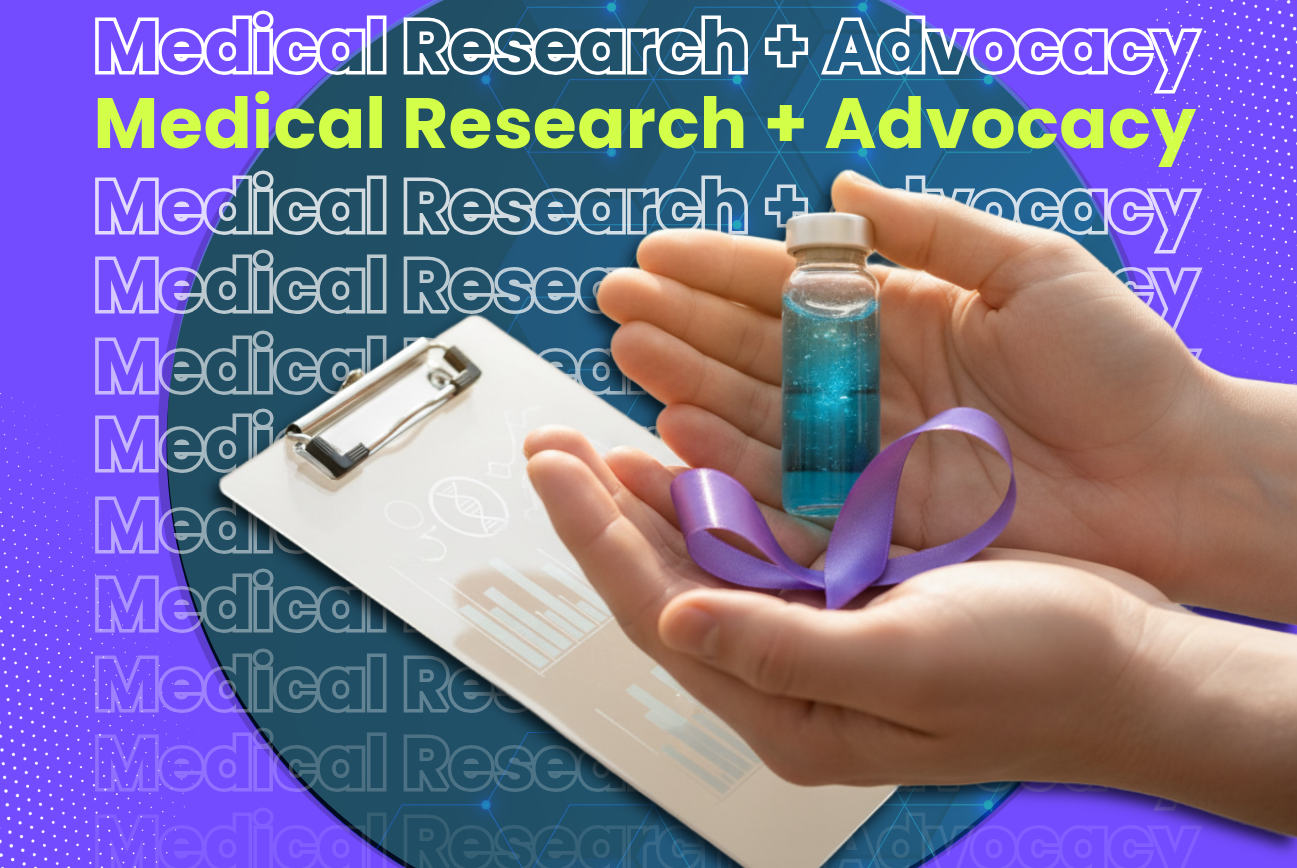
Few fundraising challenges are as complex or as inspiring as those faced by medical research and advocacy organizations. Why? Because you’re not just asking for donations. You’re asking people to believe in progress and possibility.
Fundraising for these organizations is more complex than traditional cause-based giving. The stakes are higher, the stories are more technical, and the audience is often more diverse, emotionally and financially.
However, these challenges can become your greatest strengths with the right approach.

Balancing complexity with clarity.
Telling your story is rarely simple when your mission involves funding research, clinical trials, or patient advocacy. Scientific breakthroughs take years and results are often measured in outcomes that aren’t immediately clear.
That makes it difficult to show donors how their support is making a difference right now.
The solution lies in clarity, not complexity. You’ll need to translate medical jargon into emotional language without losing credibility. It’s all about connecting the dots between what’s happening in the lab and who it’s helping in the world.
But clarity doesn’t just shape your message. It applies to how you understand your supporters, too.
LEARN MORE: Is your nonprofit suffering from boring storytelling?
Understanding your donors’ motivations.
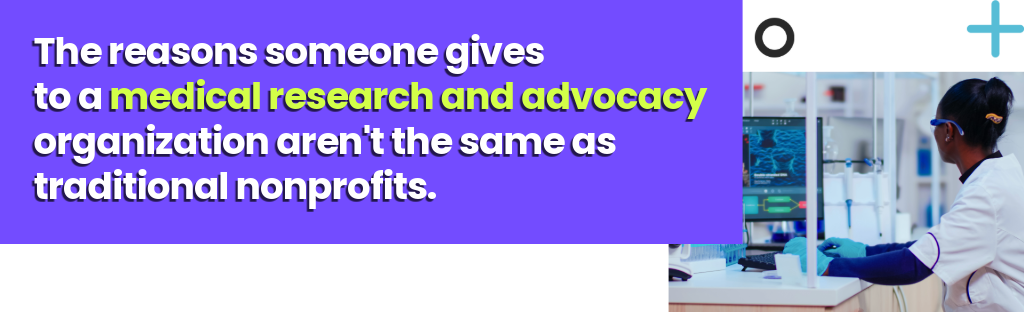
Most cause-based organizations focus on urgent needs, like feeding the food insecure, sheltering the unhoused, or protecting the environment. But the need never stops for medical research and advocacy organizations.
Your donors’ motivations are often driven by two factors:
- Personal connection: Someone who has been directly affected by the disease.
- Big-picture belief: Someone who supports science, innovation, or patient rights more broadly.
Your strategy should speak to both. You’ll need to craft emotional, personalized and story-driven appeals to nurture the donors who feel a personal connection. And you should sprinkle in data-driven updates with measurable outcomes to reassure the analytically minded supporters who are more interested in the big picture.
The key is using an approach that guides both groups toward a shared long-term vision.
LEARN MORE: Donors need to know the impact of every donation.

Connecting unrestricted giving to impact.
Restricted giving is one of the biggest hurdles facing medical research and advocacy fundraisers. That’s because donors often want to support specific programs, like a named research initiative or a patient assistance fund, while avoiding the less glamorous operational costs.
We can’t fault donors for thinking this way. But it does limit your flexibility. After all, a lab can’t function without the right equipment. And an advocacy campaign can’t get off the ground and thrive without staff.
That’s why you need a plan to communicate the importance of unrestricted support.
Now, we’re not telling you to fight against your donors’ preferences. It’s about meeting them halfway and showing how unrestricted gifts accelerate discovery and care by empowering your organization to respond quickly when opportunities arise.
You’ll need to craft messages that connect a donor’s unrestricted support to real-world outcomes. The key is helping them transition to thinking about impact rather than overhead.
Luckily, this can be easier than it sounds. Take a lesson from the American Cancer Society, which often uses “because of you” messaging to show how unrestricted support fuels rapid response to emerging research or patient needs.
LEARN MORE: The right way to compare dollars to impact.
Using hope, urgency, and authenticity.
Fundraising for medical research and advocacy organizations requires walking a fine line between optimism and realism. You risk sounding naïve if you lean too hard into hope. But you can overwhelm donors by focusing too much on urgency.
As usual, authenticity is key. Fundraising for these organizations requires honest messaging that recognizes the challenges while highlighting progress.
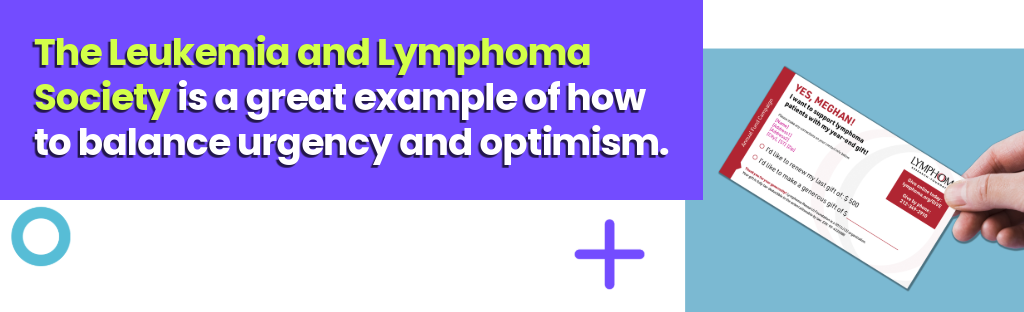
One of our clients, the Leukemia & Lymphoma Society (LLS), does this exceptionally well. Their communications strike the right balance between urgency and optimism by acknowledging the ongoing challenges of cancer research while celebrating the survivors, caregivers, and advocates who make progress possible.
Whether through campaign updates, impact stories, or appeals tied to new research breakthroughs, LLS constantly reminds donors that every gift fuels hope and tangible progress.
So, make sure every appeal helps supporters see themselves as part of something larger than a single breakthrough. It should make them feel like a key part of a movement advancing care and cures.
LEARN MORE: There’s always a new story to tell.
Turning challenges into opportunities.
The complexities that come with fundraising for medical research and advocacy organizations can become the things that set you apart, with the right strategy. Remember, you’re not just asking for donations. You’re inviting people to invest in the future of health, science, and human resilience.
Organizations like the Christopher & Dana Reeve Foundation have shown what’s possible when strategy and storytelling align. Through our partnership, we helped them create more targeted appeals and clearer communications, resulting in a 34 percent reduction in their direct mail volume while doubling their ROI without increasing budget.
But how can you put this into practice?
Start by simplifying your story and connecting every message back to the people your work helps. Share updates even when progress feels slow, while celebrating the milestones that remind supporters why their belief in your mission matters.
And don’t be afraid to experiment. Test new formats, segment your audiences, and adjust your messaging based on what resonates most.
Your fundraising program will grow stronger and more sustainable the more you understand your donors and clearly show them the impact of their giving.
If you’d like to talk through your approach, we’d love to help!